Temsili görsel (stok fotoğraf); ürünün kendisi değildir.
Bypass Cuts, Anvil Crushes
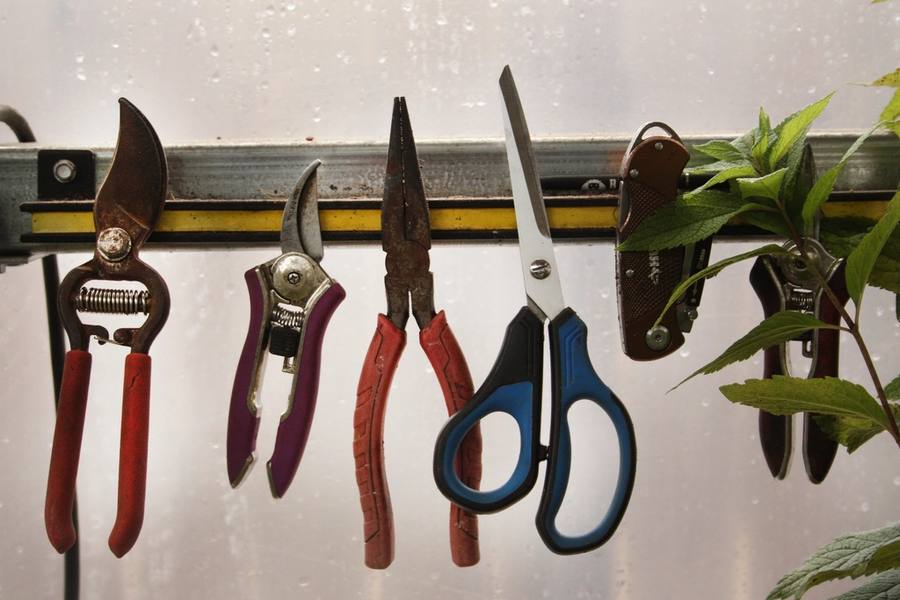
Bypass secateurs work like scissors, with a sharp blade passing a curved hook, which shears a stem cleanly with the cut face left smooth.
Anvil secateurs press a blade onto a flat plate, which crushes the stem against the anvil before severing it and leaves a bruised end.
On living wood that crushing damages the tissue around the cut and gives disease an entry point, which is why bypass is the correct tool for anything still growing.
Blade Sharpness And Wound Healing
A clean cut seals quickly as the plant forms callus tissue over it, and a ragged torn cut stays open far longer and admits fungal infection.
Sharpness is therefore a plant health matter rather than a convenience, and blunt secateurs are doing damage rather than simply being harder work.
Blades are sharpened with a diamond file along the existing bevel on the cutting blade only, which takes a couple of minutes and is worth doing several times a season.
Cut Placement Matters As Much As The Tool
A cut should be just above an outward-facing bud and angled slightly away from it, which directs new growth outward and sheds water away from the bud.
Cutting too far above a bud leaves a stub that dies back and rots, and cutting too close damages the bud itself.
Cutting flush against a trunk removes the branch collar, which is the tissue that seals the wound, and that is one of the commonest pruning errors.
Capacity And Not Forcing Them
Secateurs have a stated maximum diameter and forcing a thicker stem twists the blades out of alignment permanently, which is how most pairs are ruined.
Anything beyond that capacity needs loppers or a pruning saw, and twisting secateurs to finish a cut is the specific action that bends them.
A pair that has developed a gap between the blades no longer cuts cleanly at the tip and needs the pivot adjusting or the blades realigning.
Disease Transmission Between Plants
Secateurs carry fungal spores and bacterial infection between plants, and pruning a diseased shrub then a healthy one spreads it directly.
Wiping blades with alcohol between plants when disease is present is standard practice and is skipped by nearly everybody.
That matters most with roses, fruit trees and anything showing canker or blight, where the tool is a genuine transmission route.
Timing matters as much as technique and varies by plant, since pruning at the wrong point in a growing cycle removes the wood that would have flowered or exposes fresh cuts to frost damage. Spring-flowering shrubs flower on wood grown the previous year and are pruned immediately after flowering, while many summer-flowering ones bloom on the current season and are cut back in late winter. Getting that wrong produces a healthy plant that simply does not flower, which is the commonest pruning disappointment.
Left-handed secateurs exist and are genuinely different rather than cosmetically so, since the blade is reversed and the safety catch moves to the other side.
The Verdict
The essential garden tool where sharpness and correct use matter to plant health rather than only to convenience.
Forcing thick stems bends blades permanently, blunt blades tear wounds open, and tools spread disease between plants.
Use bypass on anything living. Anvil pruners crush the stem and leave a wound that invites infection.
Bir bakışta
Artılar
- Clean cuts that seal quickly and resist infection
- Replaceable blades and springs on better models
- Sharpen in minutes with a diamond file
- Rotating handles reduce strain on long sessions
Eksiler
- Ruined permanently by forcing oversized stems
- Blunt blades tear wounds and admit disease
- Transmit infection between plants if not wiped
- Cheap pivots develop blade gaps quickly
Sıkça sorulan sorular
Bypass or anvil?
Bypass for anything living. Anvil pruners crush the stem against a flat plate, bruising the tissue around the cut and giving disease an entry point. Anvil is for dead wood, where crushing does not matter.
How often should I sharpen them?
Several times a season. A blunt blade tears rather than shears, and a ragged wound stays open far longer and admits fungal infection. A diamond file along the existing bevel takes a couple of minutes.
Why did mine stop cutting at the tip?
The blades have been forced apart, almost certainly by twisting through a stem beyond the stated capacity. Adjust the pivot if it has one; if the blades are bent, the pair is effectively finished.
Teknik Özellikler
| Type | Bypass scissor-action secateurs |
| Use on | Living wood |
| Anvil type | Dead wood only; crushes stems |
| Sharpening | Diamond file, cutting blade only |
| Cut placement | Above an outward bud, angled away |
| Never | Cut flush and remove the branch collar |
| Capacity | Respect it; twisting bends blades |
| Hygiene | Alcohol wipe between diseased plants |
Özet
Bypass on living wood, sharp always. A crushed or torn cut is where disease gets into a plant.
Amazon'da Fiyatı Kontrol Et